Monthly Conservation Action
Learn more about what we are focusing in on this month! You can learn tips and even learn new ways you can help us collect the data we need to help protect our wild world!
Last month's action page can be found by clicking the button below.
OCtober: Saving our native bats

A Group of Misunderstood Animals
Our region is full of caves and deep wood areas that house on of the most important groups of wildlife we have: bats.
Bats are portrayed as dangerous creatures in many horror films, books, and oral stories.
The reality is that most bat species are harmless, and all of those that we have here are harmless to humans and only bite in self defense! Most of them are insectivores, eating flying insects, not drinking certain fluids from the body. With Halloween on the horizon and the final week of October being Bat Week, we want to give them an entire month to celebrate the amazing place in our local woodlands these animals inhabit.
The Biggest Problem for Local Bats
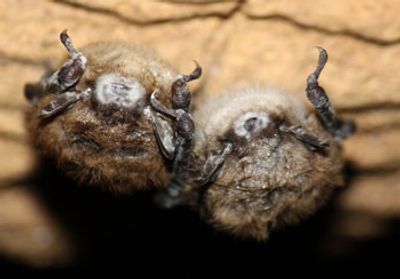
White Nose Syndrome, as shown by this photo courtesy of Indiana Department of Natural Resources, is a deadly fungal disease that affects and sadly is lethal to bat species. WNS causes the bats to wake up early from their winter hibernation which causes serious problems that ultimately end in the bat passing away.
It was first found in New York in 2006, and at least 40 states and eight Canadian Provinces have reported this fungus (https://www.fws.gov/story/preventing-and-treating-white-nose-syndrome).
Unfortunately, there is no known cure for this syndrome. However there are many studies that are showing promise. To find out more, visit the weblink above to find out what the FWS is doing.
NCMWC is creating our own program that will help fund and research efforts to combat this fungus and help wild bats recover. For more information about our efforts, visit our blog post that will be available on 10/11/2026 or our soon to be published webpage for WNS research.
Our shared endangered bats

Gray Bat
Photo credit: Bat Conservation International
Indiana Bat Cluster
Photo credit: Andrew King of the National Fish and Wildlife Service
Northern Long Eared Bat
Photo credit:
https://www.fws.gov/species/northern-long-eared-bat-myotis-septentrionalis
How you can help
Healthy Cave Exploration Practices
Report Findings of White Nose Syndrome
Healthy Cave Exploration Practices

Cleaning clothing and equipment after each trip is the easiest way to avoid bringing disease to roost caves. Avoid touching or interacting with bats or their guano (excrement) as bacteria may be transferred to the animal (or you).
Limiting Access
Report Findings of White Nose Syndrome
Healthy Cave Exploration Practices
Some caves are open during the warm months, when bats are able to find safety. Those caves should be limited for human access during the winter. If a known population of an imperiled species is found in a cave, it should be closed off to all access except for scientific research.
Report Findings of White Nose Syndrome
Report Findings of White Nose Syndrome
Report Findings of White Nose Syndrome
Write down your findings, and report them to NCMWC or the US Fish and Wildlife Service when you are able to do so. If you report it to us, we will credit you with the report, but it will allow us to have record of the finding so that we can support field work to help support the affected species